So the almighty HAL of France—an "open-access" preprint archive—stopped
allowing me to post my preprints there
based entirely on the fact that I don't have a PhD
and I'm not currently affiliated with a university,
regardless of the potential merit of my
"Tri-Quarter Framework Case Study: BPSK Signal Processing"
work. They wrote me such an authentic, polite, "open-access" email:
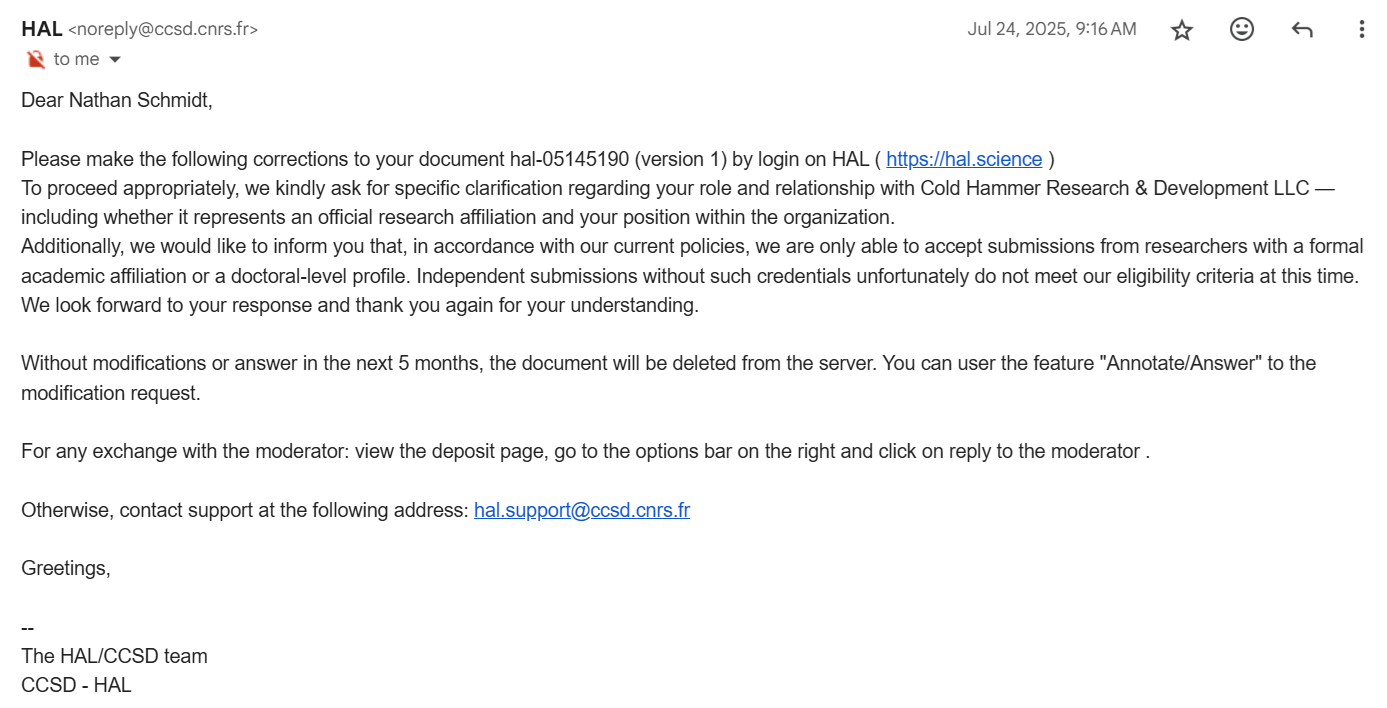
Dear Nathan Schmidt,
Please make the following corrections to your document hal-05145190 (version 1) by login on HAL ( https://hal.science )
To proceed appropriately, we kindly ask for specific clarification regarding your role and relationship with Cold Hammer Research & Development LLC — including whether it represents an official research affiliation and your position within the organization.
Additionally, we would like to inform you that, in accordance with our current policies, we are only able to accept submissions from researchers with a formal academic affiliation or a doctoral-level profile. Independent submissions without such credentials unfortunately do not meet our eligibility criteria at this time.
We look forward to your response and thank you again for your understanding.
Without modifications or answer in the next 5 months, the document will be deleted from the server. You can user the feature "Annotate/Answer" to the modification request.
For any exchange with the moderator: view the deposit page, go to the options bar on the right and click on reply to the moderator .
Otherwise, contact support at the following address: hal.support@ccsd.cnrs.fr
Greetings,
--
The HAL/CCSD team
CCSD - HAL
So I can't be a part of their cool club.
I guess 20+ years of
industry and academic experience in cutting-edge software engineering development and scientific research,
with dual M.S. degrees in computer science and math,
isn't cool enough for them. 😎
Oh well, it's their choice and their loss, not mine. 🤣